

 English
 русский
 Français
 Español
 عربى
Technical Parameters for OSD Cleanrooms
Most OSD production rooms are classified as Grade D or ISO 8, although requirements vary by country, product and guideline. Your risk assessment and local GMP rules decide the final design. The table summarizes common design references.
| Item | Typical OSD reference | Our typical solution |
|---|---|---|
| Cleanliness class | Grade D / ISO 8 for most processing rooms | Panels, flush doors, HEPA Supply Boxes |
| Air changes | Commonly 15–25 per hour, depending on dust load | Filtered supply, return or extract grilles |
| Temperature / humidity | About 18–26 °C / 40–60 % RH, tighter for sensitive products | Moisture-stable panel cores |
| Pressure | Dust-generating rooms slightly negative to corridor; corridor positive to outside | Airtight panels, interlocked airlocks |
| Dispensing and sampling | Laminar flow or extraction booth | Weighing Booth, Laminar Air Flow |
| Wall surface | Smooth, easy to wipe, resistant to dust and cleaning agents | HPL or PCGI faces |
| Door size | Wide enough for trolleys, bins and machines | Double leaf or sliding doors |
| Ceiling | Walkable or accessible for services | Walkable cleanroom ceiling panels |
Layout points: keep raw material, in-process and finished goods flows separate, use airlocks between products, and give high-dust rooms such as granulation and compression their own extraction. Avoid recesses and ledges where powder collects.
Safety note: some powders can form explosive dust clouds. Panels and doors are not explosion-protection devices, so hazardous-area design and equipment must be handled by qualified specialists.
Humidity and static: hygroscopic powders and some coating processes need tight humidity control, and dry rooms can build static charges that attract dust. We can supply anti-static finishes and airtight panels, and your HVAC designer can add dehumidification where necessary.
Cross-Border Delivery and Localized Construction Support
OSD plants are often large, with many rooms and long corridors, so efficient container loading and clear labeling save considerable time on site. We pack and label by room and by production line, so each line can be built and commissioned in sequence.
- Flat-pack efficiency: wall panels and profiles are packed flat, making good use of 40HQ containers.
- Mixed loading: panels, doors, windows, Weighing Booths and Pass Boxes can share a container to reduce freight cost.
- Documents: packing list, commercial invoice and certificate of origin, with FOB, CFR or CIF terms.
- Phased delivery: large plants can be shipped in stages that match the construction schedule.
Local installation: a trained local contractor can install an OSD plant using ordinary tools, guided by our drawings, a sequence manual and video support. We can also send an engineer for supervision. Before work starts, it is important to confirm equipment sizes and access routes, because tablet presses, fluid bed dryers and coating machines are large and often must enter before the final walls are closed.
We also advise on ceiling loads for ductwork and lighting, door widths for trolleys and floor transitions, so equipment can move easily once the plant is operating.
For multi-line plants, we recommend building and commissioning one line at a time, which allows production to start earlier and lets the team apply lessons from the first line to later ones. We adjust shipping batches to suit this approach and provide clear drawings for each stage, so every contractor knows exactly what is expected.
Quality Control and Certification
OSD plants are inspected for GMP compliance, cleaning validation and cross-contamination control. Cleanroom panels and doors are not approved individually, and we avoid claims of that kind. Our focus is on consistent manufacturing and clear records.
| Control step | Inspection | Why it matters |
|---|---|---|
| Raw materials | Sheet metal, HPL, core, profiles, gaskets | Uniform quality |
| Panel production | Dimensions, flatness, bonding, edge sealing | Straight walls, tight joints |
| Surface check | Scratches, bubbles, color, cleanability | Easy powder removal and cleaning |
| Door inspection | Leaf, frame, gasket and hardware operation | Smooth use, good sealing |
| Equipment check | Weighing Booth and Pass Box function test | Ready for installation |
| Packing | Count, labels, condition | Complete delivery |
Documents available: material specifications, factory inspection records, filter data and, where available, fire or surface performance reports. These support your design and installation qualification.
Cleaning validation depends on surfaces that tolerate your chosen detergents and are free of cracks and ledges. Please share your cleaning agents and method (dry vacuum, wet wipe or washdown), and we will advise on the face material and sealing details. Supplier audits and sample approvals are welcome.
Many OSD customers run supplier approval programs. We answer questionnaires, send sample panels and doors, and welcome audits. Our team keeps batch records, so a later question about a specific panel or door can be traced back to its production date and material source.
If a certificate is required for a tender or a customer audit, tell us at the start. We will state plainly what we can supply and avoid statements that cannot be supported. Your own cleaning validation should also confirm that the selected surface works with your detergents and wipes.
After-Sales Service and Response Capability
In OSD plants, wear and tear on doors, corners and wall bases is common, since trolleys, bins and machines move constantly. We keep full project records, so repairs and extensions can match the original system.
- Fast response: technical questions answered in English by email, phone or messaging.
- Remote diagnosis: photos or videos of damaged panels, gaskets or hinges allow a quick recommendation.
- Spare parts: door leaves, hinges, closers, handles, gaskets, windows, protective bumpers and filters.
- Line expansion: adding a new line, door or room is straightforward with modular panels.
- Maintenance advice: simple cleaning and inspection checklists.
Typical wear points:
| Location | Typical issue | Suggested action |
|---|---|---|
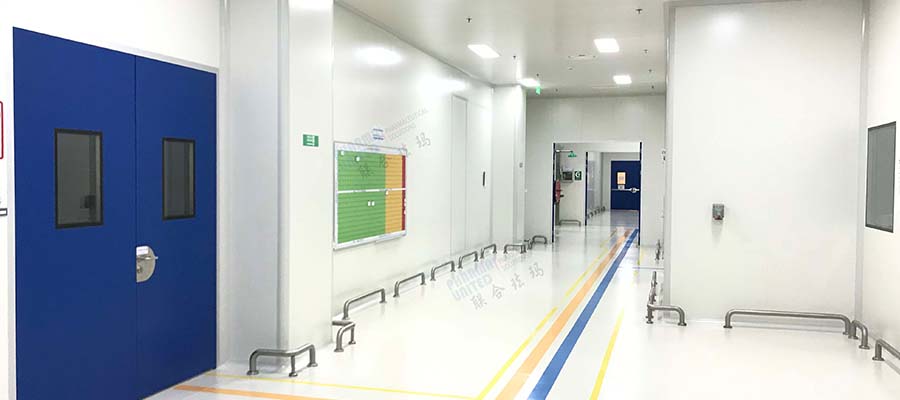
| Door edges and wall bases | Impact from trolleys | Fit protective rails, repair or replace panels |
| Door gaskets | Compression wear | Replace gasket |
| Window frames | Sealant aging | Re-seal frame |
| Ceiling access panels | Loose fittings | Tighten, reseal |
Early repair prevents small damage from turning into cleaning and containment problems.
Because OSD plants run many shifts, we suggest building a simple inspection routine into daily operations. Operators can check door closing, protective rails and visible damage, while maintenance staff review gaskets and sealant monthly. A short checklist, with photos of acceptable and unacceptable conditions, helps new staff understand what to report.
When damage is found, send us a photo and the room number. We will check the original drawings, confirm the panel or door type and prepare a replacement. For minor impact damage, we can also advise on repair methods and protective accessories that stop the problem from returning.
Commercial Terms, Warranty and Lifecycle Cost
OSD plants cover large floor areas, so small differences in price per square meter add up quickly. At the same time, repeated impact damage, poor sealing and heavy cleaning are the usual causes of extra cost during operation. A balanced specification serves buyers better than the lowest price.
| Item | Our approach |
|---|---|
| Quotation | Itemized by area and component group, with drawings |
| Trade terms | FOB, CFR or CIF, defined in the quotation |
| Payment | Commonly a deposit with balance before shipment or against documents; final terms in the contract |
| Warranty | Defined by component group in the contract |
| Lead time | Given after drawing confirmation |
| Customization | Size, thickness, color, protective rails, door sizes |
Ways to control lifecycle cost:
- Use impact protection at corners, door edges and wall bases where trolleys pass.
- Choose HPL or stainless faces where washdown is used.
- Use economical PCGI faces in dry, low-wear areas.
- Keep the system modular, so lines can be added or moved.
- Improve airtightness to reduce fan energy.
Equipment, HVAC, dust extraction, electrical installation and permits are outside our supply and should be added to your budget. Warranty exclusions are clearly stated in the contract.
Another factor is the speed of construction. Modular panels go up faster than brick-and-plaster rooms, which means production can start earlier and income begins sooner. When you compare options, include the value of finishing a few weeks earlier. We are happy to provide a rough installation sequence so that you can estimate the saving for your own plant.
Real Factory Strength for OSD Projects
OSD plants are large projects, so volume capacity and delivery discipline are essential. Pharma United Co., Ltd., founded in 2006, runs two factories in Kunshan and Qianjiang covering 20,000 m², with more than 60 staff. We are a manufacturer, not a trading company.
| Indicator | Information |
|---|---|
| Experience | 20+ years in cleanroom engineering |
| HPL cleanroom panels | About 250,000 m² per year; China's largest HPL cleanroom panel manufacturer |
| Container shipments | More than 1,000 forty-foot high-cube containers per year |
| Location | Kunshan, near Shanghai port |
| Product range | Panels, doors and windows, equipment, PODs, HEPA products |
| Service | Design, manufacture and installation support |
What this means for an OSD buyer: large panel output supports big areas with consistent color and flatness, and our export experience means containers are loaded efficiently. Because we also make Weighing Booths, Pass Boxes and Air Showers, the whole plant can use matching finishes and dimensions.
Factory visits, samples, references and video tours are available.
Our designers prepare layouts and detailed drawings, our engineers review door sizes, ceiling loads and openings, and our production teams run dedicated lines for panels, doors and booths. Because these steps happen under one roof, answers to technical questions arrive quickly, and design changes can be passed directly to production.
Customers regularly return for new lines, additional rooms and spare parts, which reflects how our systems perform in daily use.
Samples, photos and videos of completed plants are available on request.
Our staff reply to technical questions promptly and in plain language.
OSD Plant Cleanroom Materials FAQ
Q1. What cleanliness grade does an OSD plant need?
Many guidelines call for Grade D or ISO 8 in production rooms, but requirements differ by country and product. Your regulator and risk assessment decide.
Q2. How do I prevent cross-contamination?
Through room layout, airlocks, pressure differentials, dedicated extraction, validated cleaning and sealed, easy-to-clean surfaces. Our products support the physical part of this approach.
Q3. Do you supply dispensing booths?
Yes. We supply Weighing Booths and Laminar Air Flow units for dispensing and sampling.
Q4. Which panel is best for OSD rooms?
HPL and stainless faces suit washdown areas, while PCGI faces are economical for dry areas. We advise based on your cleaning method.
Q5. Are your panels explosion-proof?
No. Where combustible dust or solvents are present, explosion-protection design must be handled by qualified specialists.
Q6. Can a plant be built in stages?
Yes. Modular systems allow additional lines to be added later.
Q7. How do I start?
Send your product list, equipment layout, floor plan and destination country.
Q8. How should I choose between HPL and PCGI faces?
HPL offers better resistance to moisture and repeated washdown, while PCGI is economical for dry areas. Mixed use within one plant is common.
Q9. Can you supply walkable ceilings?
Yes. Walkable ceiling panels allow maintenance access to ducts, lights and services without entering the production room.
Q10. Can I upgrade a Grade D area later?
Often yes, by improving airlocks, filtration and surfaces within the same modular envelope.