

 English
 русский
 Français
 Español
 عربى
Technical Parameters for Sterile Injectable Rooms
The table lists common design references for the main room types in an injectable plant. Your contamination control strategy, the current EU GMP Annex 1 or FDA guidance, and local law decide the final requirements. Values shown are typical, not a substitute for your own design.
| Room or zone | Typical grade (EU) / class (ISO) | Typical design features |
|---|---|---|
| Aseptic filling and stoppering | Grade A in Grade B background (ISO 5 in ISO 5/7) | Unidirectional airflow, flush surfaces, interlocked airlocks |
| Aseptic connections and setup | Grade A in Grade B | Laminar Air Flow, sealed walls and ceiling |
| Solution preparation (to be sterile filtered) | Grade C (ISO 7 at rest) | Smooth panels, HEPA Supply Boxes, easy to clean |
| Component preparation and washing | Grade C or D | Moisture-resistant panels, floor drains outside critical areas |
| Gowning rooms and airlocks | Graded by stage, B to D | Step-over bench, Air Shower, interlocked doors |
| Corridors and support areas | Grade D (ISO 8) | Economical panels, flush doors |
Common design points:
- Pressure differentials of about 10–15 Pa between rooms of different grade, with Grade A and B at the highest pressure.
- No sinks or drains in Grade A and B rooms, and carefully sealed floor drains elsewhere.
- Pass Boxes or interlocked airlocks for material transfer instead of open doorways.
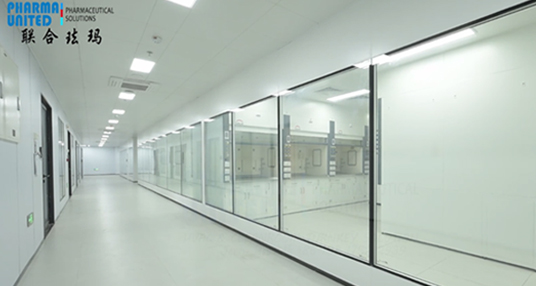
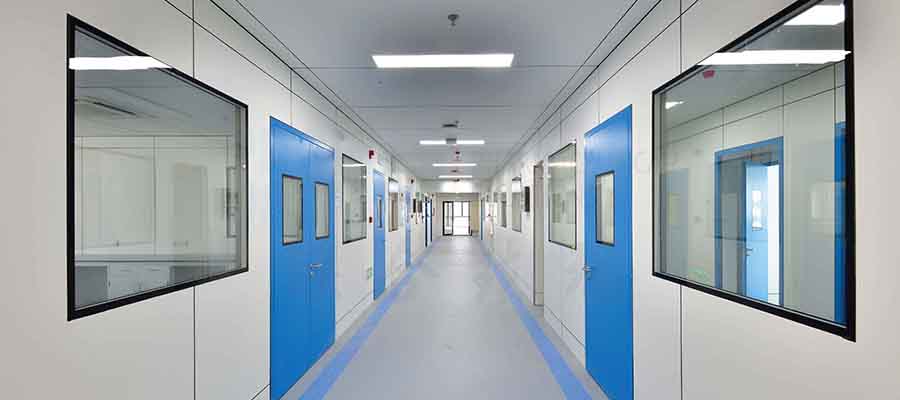
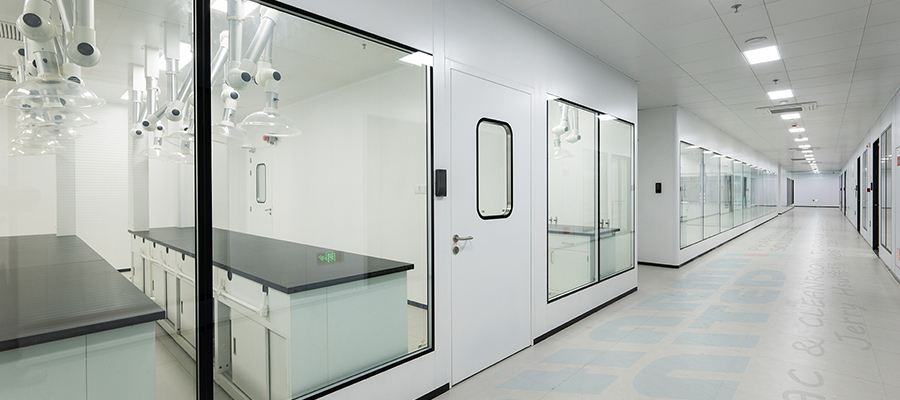
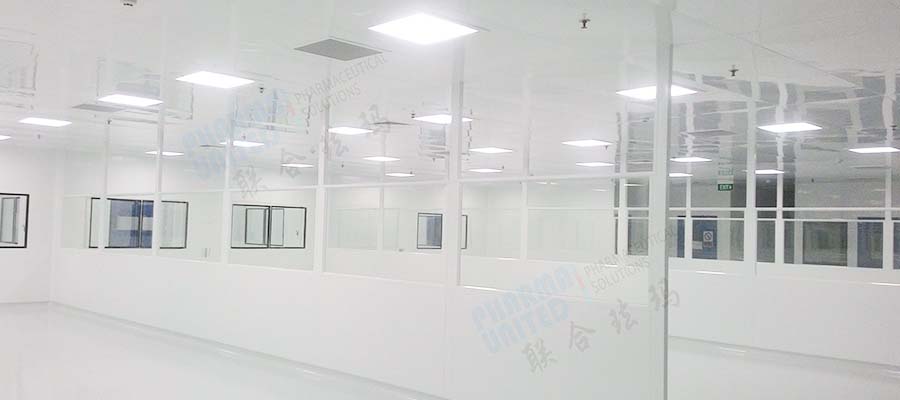
- Viewing windows that allow supervisors to observe filling without entering the room.
We can customize panel size, thickness, color and door layout for each room.
Window positions, lighting and ceiling access also deserve early attention, since they affect both operator comfort and the ability of maintenance staff to reach services above the room without disturbing the clean area.
Cross-Border Delivery and Localized Construction Support
An injectable plant is a complex project in which cleanroom contractors, HVAC teams, process equipment suppliers and validation specialists all work in the same building. Our delivery plan is therefore tied to the sequence of the whole project, not only to the factory schedule.
- Layout and grade review: we confirm the room list, grade map, personnel and material flow and airlock positions.
- Production and pre-fit: panels, doors and frames are produced to drawing, numbered, and key interfaces are test-fitted.
- Staged shipping: critical rooms such as filling and Grade B background can be shipped first.
- Export documents: packing list, commercial invoice and certificate of origin, with FOB, CFR or CIF terms.
- Site guidance: labeled drawings, installation manual, video guidance or supervising engineer.
Working with local trades: filling line suppliers often need wall openings, utility penetrations and equipment access routes that must be planned well before the walls are built. We help mark these on the drawings and confirm clearances for equipment such as lyophilizers and autoclaves, which are usually installed before the final walls close.
We also recommend a clean construction approach: protect finished surfaces, avoid cutting inside the finished room, and complete the cleaning before filters are installed. Your validation team then tests airflow, filter integrity, pressures and particle counts before commissioning continues.
Because lyophilizers, autoclaves and tunnels are heavy and often delivered late, we suggest agreeing a clear equipment entry plan, including temporary wall panels or removable sections, so large items can be moved in without damaging finished walls or reopening sealed joints.
Quality Control and Certification
Sterile injectable facilities are inspected by regulators in terms of the whole quality system and contamination control strategy. No wall panel or door receives a stand-alone approval for sterile production, so we do not make such claims. What we offer is consistent manufacturing and records that support your qualification.
| Control step | Inspection | Why it matters |
|---|---|---|
| Incoming material | Facing sheet, core, profiles, gaskets, glass | Known base quality |
| Panel production | Dimensions, flatness, bonding, edge sealing | Tight flush joints |
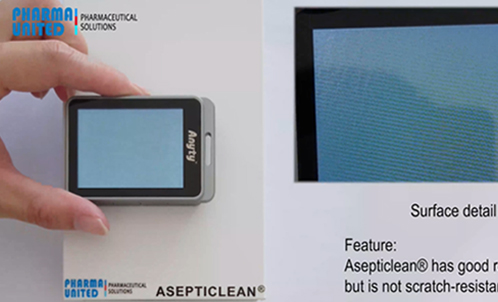
| Surface inspection | Scratches, bubbles, color, cleanability | Easy and reliable cleaning |
| Door and window | Gasket compression, interlock and hinge function | Pressure stability |
| HEPA products | Factory efficiency records, visual check | Filter traceability |
| Packing | Piece count, labels, condition | Complete, undamaged delivery |
Documents available: material specifications, factory inspection records, filter data and, where available, test reports for fire or surface performance. These can be added to your DQ and IQ files.
Surfaces in sterile areas face frequent disinfectants and sporicidal agents. Tell us your cleaning agents and rotation, and we will advise on compatible faces and sealants. We welcome supplier audits, sample approval and questionnaires from your quality unit.
Sterile projects usually pass through a formal supplier qualification step. We support this by answering technical questionnaires, sharing sample panels and doors for disinfectant testing, and showing how each batch is recorded. Our team can also host a factory audit or a live video tour, so your quality unit can judge our process directly and ask any questions on materials, assembly, inspection and packing.
We would rather agree what can be documented before the order than discover gaps during your qualification.
After-Sales Service and Response Capability
Interruptions in a sterile plant are expensive, because a batch may be lost and the room may need re-qualification. We therefore concentrate on fast diagnosis and exact replacement parts, supported by complete project records.
- Responsive support: technical questions answered in English by email, phone or messaging.
- Remote troubleshooting: photos and short videos of gaskets, hinges, windows and joints usually allow a first diagnosis.
- Spare parts: gaskets, hinges, closers, handles, interlock components, windows, lights and HEPA Filters.
- Modification support: new doors, pass boxes or rooms can be added with updated drawings for your change control.
- Engineer visits: by arrangement for repair or expansion.
Routine checks we recommend:
| Task | Frequency |
|---|---|
| Door closing and interlock function | Daily by operators |
| Gaskets, hinges and sealant | Monthly |
| Surface condition and corner sealing | Every six months |
| Filter integrity and pressure verification | As defined in your quality procedures |
Please record every repair, since inspectors often review the maintenance history of critical rooms.
Where an urgent problem occurs, such as a damaged door gasket in a Grade B corridor, we ask for a short description, photos and, if possible, a video. Our engineers compare these with the stored drawings and the bill of materials, identify the exact part and prepare it for shipment, while discussing the fastest transport route with you.
We recommend keeping a small stock of gaskets, hinges, sealant and window units on site, so maintenance staff can react the same day. For customers with several sites, a common specification and a shared spare list make support simpler and faster.
If you plan a later expansion, we can also review the existing room and propose a layout that connects new modules neatly.
Commercial Terms, Warranty and Lifecycle Cost
The total cost of an injectable plant is dominated by process equipment and HVAC, but the building envelope has an outsized effect on everything else. An airtight, durable and easily cleaned envelope lowers energy use, shortens cleaning time and protects your qualified status.
| Item | Our approach |
|---|---|
| Quotation | Itemized by room and component, with drawings and a bill of materials |
| Trade terms | FOB, CFR or CIF, defined in the quotation |
| Payment | Commonly a deposit with balance before shipment or against documents; final terms in the contract |
| Warranty | Defined by component group in the contract |
| Spare parts | Recommended list provided with the proposal |
| Customization | Size, thickness, color and door configuration on request |
Where to invest and where to save:
- Invest in surfaces, sealing and interlocks around Grade A and B areas, where failures are the most costly.
- Balance cost and durability in Grade C preparation rooms.
- Save with economical panels in Grade D corridors and support rooms.
- Plan for expansion with modular layouts that allow new lines to be added.
Remember to budget for items outside our scope, such as filling lines, isolators, HVAC, monitoring, qualification and permits. Warranty exclusions, for example damage from unsuitable chemicals or unauthorized changes, are written clearly in the contract.
When comparing quotations, check that each supplier includes the same items: cove profiles, window type, door hardware, ceiling panels, interlocks and packing. Missing items are a common cause of later cost increases, and a clear itemized list lets you compare real scope rather than headline price.
Real Factory Strength for Injectable Projects
For sterile production, buyers want a supplier who is stable and open about its capabilities. Pharma United Co., Ltd. was founded in 2006 and operates two factories in Kunshan and Qianjiang with a total area of 20,000 m² and a team of more than 60 staff. We are a manufacturer, not a trading company.
| Indicator | Information |
|---|---|
| Experience | 20+ years in cleanroom engineering |
| HPL cleanroom panels | About 250,000 m² per year; China's largest HPL cleanroom panel manufacturer |
| Container shipments | Over 1,000 forty-foot high-cube containers per year |
| Location | Kunshan, about 30 km from Shanghai |
| Product range | Panels, doors and windows, equipment, modular PODs, HEPA products |
| Service | Design, manufacture and installation support |
Why it matters for injectables: many joints and interfaces determine whether a graded facility holds its pressure cascade. Because panels, doors, windows and airlock equipment are made by one company, dimensions and finishes match and site adjustment is minimized.
Our output volume supports stable raw material supply and consistent finish across large orders. Factory audits, sample panels, project references and video tours are available on request.
Our designers prepare layouts, door and window schedules and ceiling plans, while our engineers review sealing details and interfaces with other trades. Production supervisors manage the panel and door lines, and export coordinators handle packing and documents. This structure gives you a single contact for the whole project, and it keeps technical answers consistent from drawing to delivery.
Photos, videos and references from comparable cleanroom projects can be shared on request.
Our staff reply promptly and clearly to technical questions.
Sterile Injectable Facility Supplies FAQ
Q1. What grade is needed for aseptic filling?
Under EU GMP, open aseptic operations take place in Grade A, with a Grade B background. FDA guidance uses ISO 5 for the critical area and ISO 7 for the supporting area.
Q2. Do you supply isolators and filling lines?
No. Those come from specialist manufacturers. We supply the room envelope, doors, windows, Pass Boxes, Laminar Air Flow units and HEPA components, and coordinate interfaces with equipment suppliers.
Q3. Are your panels approved for sterile use?
No product receives such an approval alone. Our panels have smooth, sealed, cleanable surfaces that support your design and qualification.
Q4. Which surface suits frequent disinfection?
HPL and stainless steel faces are common. Send us your cleaning agents for a recommendation.
Q5. Can existing buildings be converted?
Yes, modular panels are widely used for retrofits, but ceiling height, structure and utilities must be checked.
Q6. Can you help with pass-through design?
Yes. We advise on Pass Box types, interlocks and airlock layouts for component and material transfer.
Q7. How do I request a quotation?
Send your layout, grade map, process flow and destination country.
Q8. What is the difference between terminal sterilization and aseptic filling?
In terminal sterilization the product is sterilized in its final container, so the filling environment is less demanding. In aseptic filling, the product and container are sterilized separately and assembled in a Grade A zone, which calls for the strictest controls.
Q9. Do you offer sample panels?
Yes, samples can be sent for testing with your disinfectants.