

 English
 русский
 Français
 Español
 عربى

Lithium Battery Cleanroom Design: Dry Rooms, Humidity and Material Choices
If you have spent any time around a lithium battery project, you will have noticed that two different engineering languages get used in the same meeting. The process team talks about dew point, electrolyte filling and moisture ingress. The facility team talks about ISO classes, air changes and pressure cascades. Both are describing the same building, and the success of the plant usually depends on how well those two conversations are joined together.
We have spent years building controlled environments for pharmaceutical, medical and industrial clients, and battery work has become one of the most demanding corners of that portfolio. This article walks through what actually matters when you plan a lithium battery cleanroom, where a dry room fits into the picture, which materials and details hold humidity out, and how to avoid the expensive mistakes that only show up after the first cells come off the line.
Why a Lithium Battery Plant Needs a Controlled Environment
A lithium-ion cell is a very sensitive assembly. Its active materials, its electrolyte and its current collectors all react badly to things that are completely normal in an ordinary factory: water vapour, dust, metal particles and temperature swings. Those reactions do not announce themselves immediately. They appear later as capacity fade, gassing, swelling, elevated self-discharge or, in the worst case, an internal short.
So the controlled environment is doing two separate jobs at once, and it helps to keep them separate in your head before you start drawing layouts.
- Particle control protects the cell from physical contamination. A single metal particle trapped during stacking or winding can pierce a separator and create a defect that no inspection station will catch.
- Moisture control protects the chemistry. The electrolyte salt used in most lithium-ion cells hydrolyses in the presence of water, producing acidic species that attack the cathode and the solid electrolyte interphase.
Both jobs are delivered by the same envelope, the same HVAC system and the same operating discipline, which is exactly why the design conversation needs to happen early rather than after the shell and core is finished.
Cleanroom and Dry Room: One Envelope, Two Jobs
People often ask whether they need a cleanroom or a dry room. In battery manufacturing the honest answer is usually both, combined into a single graded envelope. The cleanroom side governs how many particles are allowed per cubic metre. The dry room side governs how much water vapour is present. On paper they are different specifications. In construction they share walls, doors, ceilings and air handlers.
| Design point | Cleanroom focus | Battery dry room focus |
|---|---|---|
| Primary target | Particles per cubic metre | Dew point and moisture ingress |
| Typical metric | ISO 14644 class, for example ISO 7 or ISO 8 | Supply air dew point, often minus 40 C or lower |
| Envelope priority | Smooth, cleanable surfaces and tight filtration | Airtight joints, vapour barriers and thermal breaks |
| Air strategy | Air changes, HEPA filtration, pressure cascade | Dehumidified supply air, minimal infiltration, low air leakage |
| Main risk if underdesigned | Yield loss from contamination defects | Electrolyte degradation, gassing, poor cycle life |
The practical result is a building in which humidity requirements tighten as you move towards the core. Coating and mixing areas may only need particle control and solvent safety. Stacking, winding, electrolyte filling and sealing sit at the centre of the envelope, where both particle and humidity specifications are at their strictest.
The Numbers That Shape the Design
Every battery project has its own process specification, and the final values should always come from the cell maker and the equipment supplier. What we can share are the ranges that come up again and again when we are asked to build these spaces. They are useful starting points for early feasibility work and budget conversations.
| Process area | Cleanliness | Moisture target | Main engineering concern |
|---|---|---|---|
| Mixing and coating | ISO 8 | Ambient or lightly dried | Solvent recovery and fire safety |
| Calendering and slitting | ISO 8 | Moderate, dry | Particle generation from cutting |
| Stacking and winding | ISO 7 | Low dew point | Metal particle and static control |
| Electrolyte filling and sealing | ISO 7 or stricter | Lowest dew point in the plant | Humidity ingress through openings |
| Formation and aging | ISO 8 | Temperature driven | Fire risk and thermal management |
| Module and pack assembly | ISO 8 | Moderate | ESD control and high voltage safety |
Two numbers deserve extra attention because they drive cost more than any other decision. The first is the dew point you actually need. Pushing from a moderate dry condition to a very low dew point is not a linear cost increase, because it changes the dehumidification technology, the air quantity and the airtightness standard all at once. The second is the volume of the dry space. Every extra square metre of strict dry room has to be dehumidified, lit, monitored and maintained for the life of the plant.
Materials and Envelope Details That Decide Humidity Performance
Humidity control is often described as a machine problem, but a large part of it is a detailing problem. A desiccant system sized perfectly will still struggle if the room leaks, if the joints are not sealed, or if moisture migrates through the wall assembly from a warmer adjacent space. We have seen more dry room performance issues caused by a badly resolved door frame than by an undersized dehumidifier.
The wall and ceiling assembly
Prefabricated insulated panels are the standard choice for battery environments because they are fast to install, cleanable and dimensionally stable. The core material matters: polyurethane and PIR panels offer good thermal performance, which helps keep surface temperatures above the dew point and reduces the risk of condensation on the room side. Where fire compartments are required, mineral wool cores are used and the fire strategy should be agreed with the local authority and the insurer at concept stage.
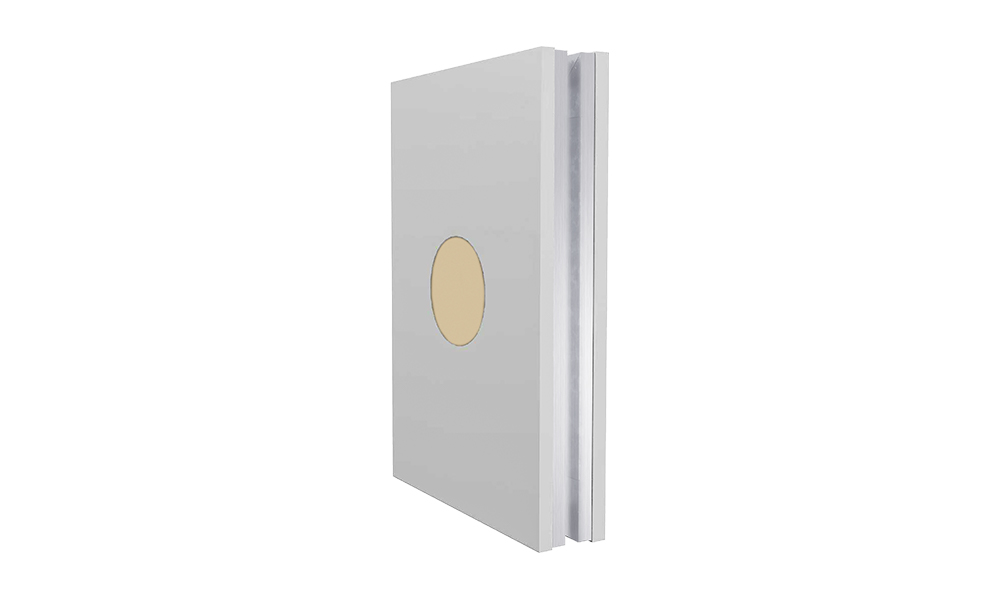 PU Insulated Cleanroom Wall and Ceiling PanelsPolyurethane-cored cleanroom panels for walls and ceilings, offering thermal insulation and cleanable surfaces; available in multiple thicknesses and finishes.View Product →
Whichever panel is selected, the details matter more than the datasheet. Joints should be designed with a continuous vapour barrier, not simply a decorative sealant line. Penetrations for pipework, cable trays and ductwork need proper boots rather than mastic bridges. Anywhere a metal fixing passes from the outside to the inside, a thermal break should be considered, because a cold point is where condensation will show up first.
Doors, interlocks and transfer points
Doors are the weakest part of any dry room envelope, and they are also where people behave least predictably. For battery spaces we generally recommend one of two approaches: sliding doors with a reliable seal for high traffic, or an interlocked arrangement in which one door cannot open until the other is closed. The interlock approach costs a little more upfront and saves far more in humidity recovery time.
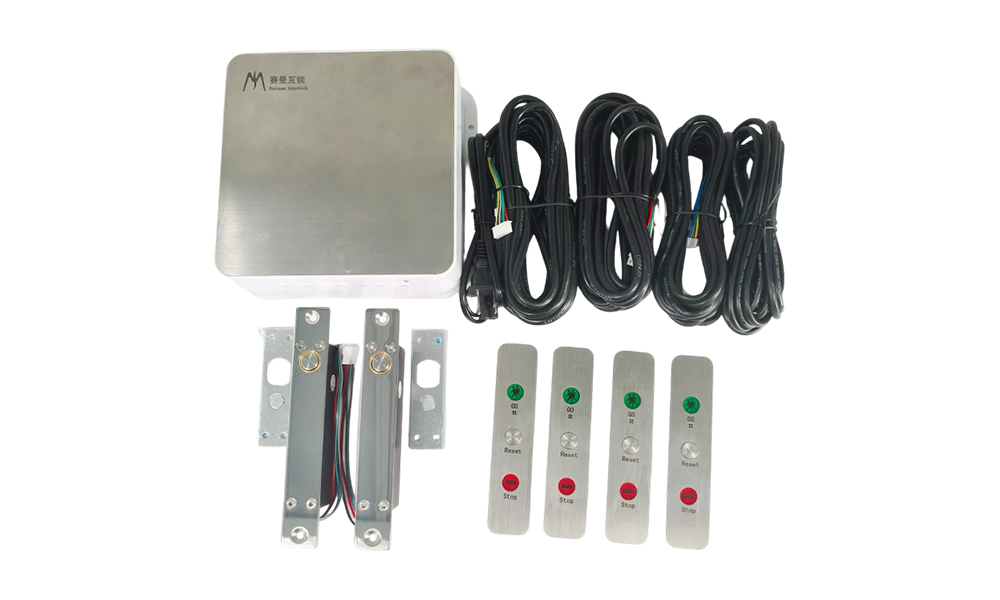 Cleanroom Door Interlock Access Control SystemInterlocked door control for airlocks and transfer areas, helping maintain pressure and cleanliness by preventing simultaneous door opening in controlled cleanroom environments.View Product →
Material transfer deserves the same care as personnel movement. A pass box keeps the separation between a dry corridor and a dry working area intact when the volume of small components is high. Air showers at the entrance to the main envelope help remove particles from garments before people enter, and they also act as a small buffer that limits the moment of open contact between the dry room and the outside air.
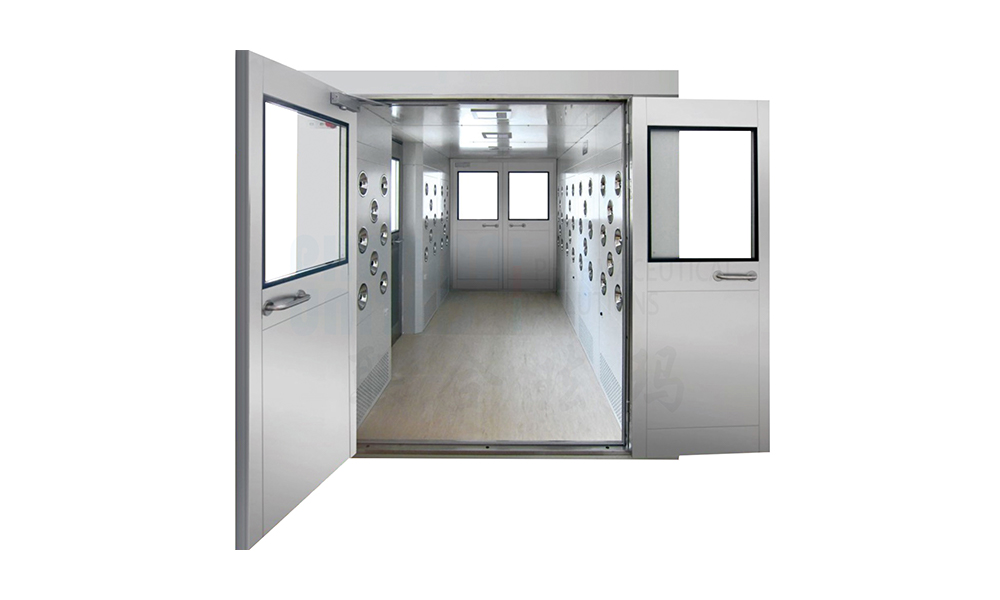 HEPA-Filtered Cleanroom Air Shower Entry UnitPersonnel and goods air shower using high-velocity HEPA-filtered jets to reduce particle transfer at cleanroom entrances; customized size and SS304 construction.View Product →
Ceilings should be walkable if maintenance above the clean space is expected, otherwise every filter change becomes a temporary breach of the envelope. HEPA terminal units, diffusers and light fittings need to be selected as part of the sealing strategy, not added afterwards.
Layout and Pressure Cascade
A good layout makes the whole plant easier to operate. The logic we prefer is a step-down cascade from the outside in: a normal production corridor, then a gowning zone, then a buffer or ante room, and finally the strict dry area. Each step should be held at a slightly lower pressure, so that air always wants to move outward rather than inward when a door is opened.
A few layout rules of thumb are worth repeating:
- Separate people from materials. A shared airlock for both is a permanent source of humidity excursions.
- Keep solvent handling and high voltage testing in their own zones with their own ventilation and fire strategy.
- Put the wettest adjacent spaces, such as washrooms and utility corridors, as far from the dry core as possible.
- Design for service access outside the strict zone wherever the equipment allows it.
- Leave a planned expansion edge. Battery lines rarely stay the size they were planned at.
Pressure differentials of ten to fifteen pascals between adjacent grades are common, but the specific values should be agreed with your process engineers and confirmed by a room pressure map during commissioning.
Humidity Control: The Heart of the HVAC Design
The HVAC system in a battery dry room is really a humidity control system that happens to deliver filtered air. The usual approach is a desiccant rotor that dries the supply air well below the room set point, followed by reheat to the supply temperature, and then distribution through HEPA filters into the space. Designing the supply dew point below the room target gives the system a buffer for infiltration and internal moisture release.
Three details separate a comfortable system from a fragile one. First, redundancy. A single desiccant rotor that stops for maintenance takes the whole dry room with it, so a lead and lag arrangement is often the sensible choice. Second, sealing. A pressure hold test on the finished envelope is one of the cheapest quality checks available, and it should be part of commissioning rather than an afterthought. Third, instrumentation. Dew point sensors drift, so the control strategy should include calibration routines and a monitoring layout that reflects how the room is actually used, not just the drawing.
It is also worth thinking about how the room behaves at startup, after a shutdown and during a product change. Recovery time is a design parameter, and it should be discussed before the equipment is ordered.
Safety, Standards and Validation
Battery plants combine three hazards that are usually handled in separate buildings: flammable solvents, high voltage and reactive chemistries. The cleanroom design has to serve all three without compromise.
On the standards side, ISO 14644 provides the framework for classifying and testing cleanliness, and it is the reference most customers expect to see in the validation documentation. Fire strategy should be developed with the local code authority and the insurer, and it may drive the choice between mineral wool and polymer core panels, the layout of fire compartments and the location of smoke extraction. For pack assembly areas, electrostatic discharge control should be treated as a design discipline in its own right, covering flooring, finishes and grounding.
Validation for a battery environment typically includes particle counting at classification, a room pressure map, dew point mapping under load, a leak or pressure hold test on the envelope, airflow visualisation at critical transfer points, and a documented IQ, OQ and PQ sequence. Bringing the validation plan into the design stage means the testing is designed in, not improvised later.
Retrofit, Modular and Expansion Options
Not every battery project starts with a green field. A significant share of our work involves carving a dry room out of an existing factory, or adding capacity into a building that was never designed for it. Retrofits are perfectly feasible when the existing slab, ceiling height and structural capacity are assessed honestly at the start, and when the new envelope is treated as a sealed box within the old building rather than as a set of coatings and partition walls.
For pilot lines, research facilities and small volume production, modular pods have become a practical alternative to a full fit out. The room arrives as an engineered assembly, is commissioned quickly, and can later be relocated or expanded. For established manufacturers, the same logic applies to phased expansion: build the strict core once, then add adjacent areas as the line grows.
Working With a Turnkey Partner
The most common cause of a humidity problem is not a failed component. It is a gap between the party that designed the room, the party that made the panels, and the party that installed the doors and the air handling equipment. When those three are separate, nobody owns the final dew point performance.
A turnkey approach closes that gap. Our work in this sector covers the full chain: concept and layout, panel and door manufacturing in our own facilities, HVAC integration, installation, and commissioning with documentation. It means the person who designed the envelope is standing next to the person who seals the last joint, and both of them are still there on the day the dew point is measured.
If you are at the feasibility stage, the most useful first step is a short technical conversation about your process areas, your dew point targets and your building constraints. From there we can outline an integrated cleanroom turnkey solution and a realistic programme. If your core requirement is moisture rather than particles, our lithium battery dry room page goes deeper into the dehumidification side.
Frequently Asked Questions
Do I need a full cleanroom if I only assemble cells?
In most cases yes, but the class can be modest. Assembly areas are usually specified at ISO 7 or ISO 8, and the important part is the combination of particle control, humidity control and disciplined transfer procedures, rather than a very high classification across the whole building.
What dew point should I specify?
This depends on your chemistry and your process step. Electrolyte filling areas usually call for the lowest dew point, while mixing and coating may need little or no dehumidification. Ask your process team for a specification per area, then design the envelope to hold it with a margin.
Can an existing building be converted into a battery dry room?
Usually yes, provided the slab can carry the loads, the floor to ceiling height allows ductwork and services, and the new envelope can be built as a sealed box. The main risks in a retrofit are thermal bridges and uncontrolled air paths, both of which can be solved at the detailing stage.
How long does construction take?
For a single production zone the installation of panels, doors and ceilings is typically measured in weeks rather than months, but the HVAC and commissioning sequence usually sets the overall programme. Early involvement of the dehumidification supplier shortens the critical path significantly.
What is the most common mistake you see?
Designing the humidity system before the envelope details. A desiccant system cannot compensate for unsealed penetrations, uninsulated cold surfaces or doors that do not close properly. Fix the box first, then size the machine.
A lithium battery cleanroom is not a difficult concept. It is an ordinary controlled environment with an unusually strict attitude towards water. The projects that go smoothly are the ones where the process specification is clear, the envelope is detailed with real care, and one team is accountable for the dew point reading on the day of handover. Get those three things right and the rest of the plant has a much better chance of running quietly, year after year.


-
Mobile
+86-177 1554 8238
-
E-mail
chin@pharma-united.com
-
Address
No.58 Beiyuan Road, Dianshanhu Town, Kunshan City, Jiangsu Province, China
Copyright © Pharma United Co., Ltd. Rights Reserved.
OEM/ODM Cleanroom Engineering Solution Manufacturers
